fox

In our backyard, February 12, 2023
It is a common experience: I was standing at the kitchen sink washing fruit for lunch and staring out the window overlooking the backyard when something interesting happened. A fox came creeping out of the trees into the open. He was obviously stalking one of the many other small creatures living in my backyard, probably a squirrel.
I hesitated to get my camera because I feared opening the glass door to the backyard would startle the fox and it would run away, but I tried it anyway and, to my surprise, the fox didn’t seem to care. He just gazed over at me with an insouciant stare and then went back to sizing up his prey.
I never saw the animal he was after.
Monte
reimagine
The Beach is my favorite place to sort out the anxieties induced by current events. Frequently I find myself staring at the ocean and wondering why humanity can't do better? Why can't we work together toward solving the challenges, many of them of our own making, that threaten us? The inspiration for this short video happened while watching the sunset at Chapoquoit.
Monte
the edge of the sea
A passage from Rachel Carson's book, The Edge of the Sea, inspired this video. Carson wrote of the sense she got at the beach that the creatures were connected to each other and to their surroundings. As the human impact on Earth produces more environmental calamities, I am hopeful that we can save ourselves from ourselves by learning to appreciate the rareness of a planet like Earth. Carson's love of the natural world is as relevant today as it ever was.
eating crepidula - extended version
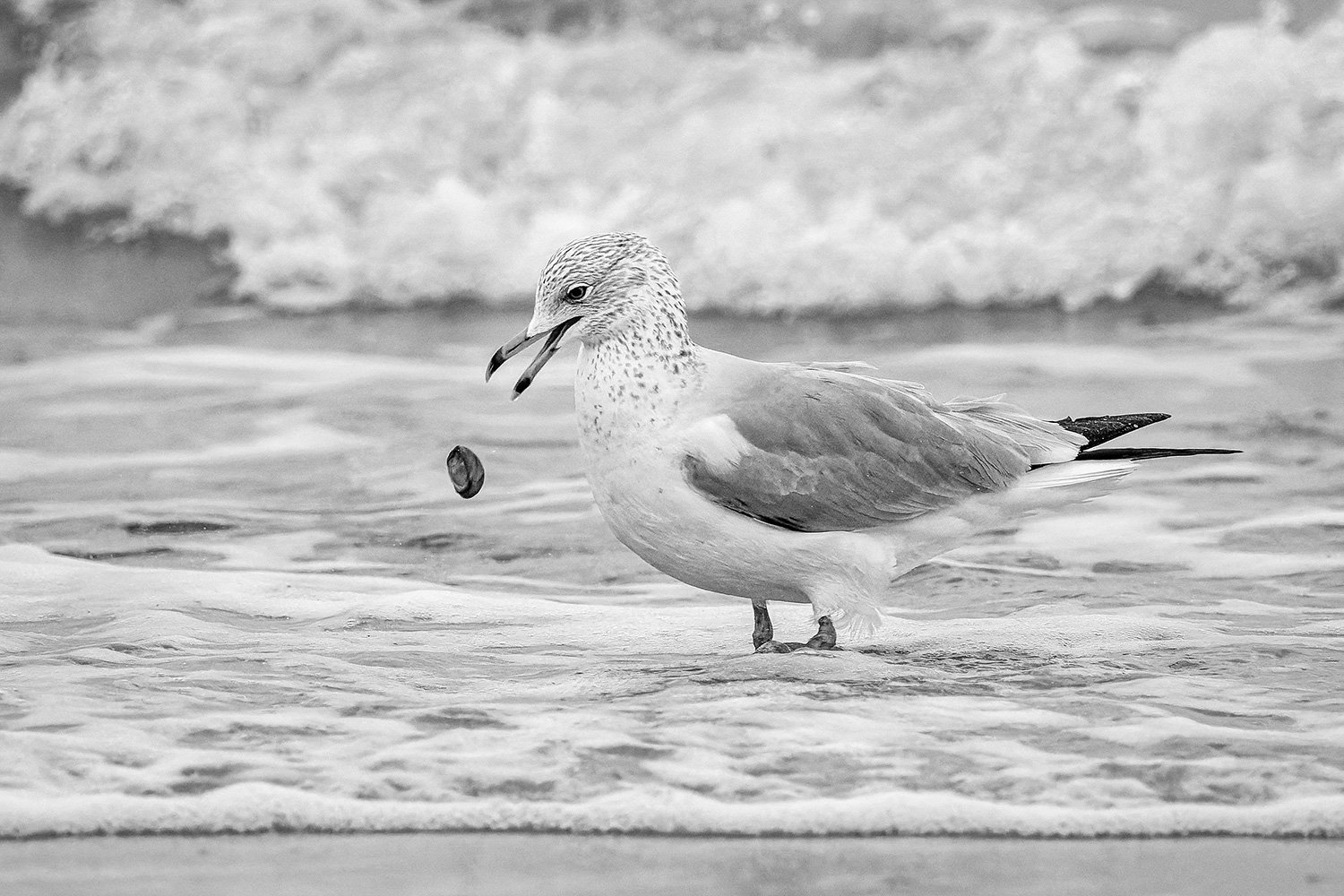
I was lucky enough to encounter a couple of marine biologists while photographing the seagulls and sanderlings eating sea snails at Chapoquoit beach. They told me the name of the snails, Crepidula Fornicata, and provided a brief lesson on them as well as a sidebar on the egg case of a Whelk.
Just another great experience at Chapoquoit beach.
Monte
eating crepidula
I’ve been watching the gulls and the sanderlings eating snails they snatch out of the surf at Chapoquoit over the past few days. I went out in the snow just after sunrise today to get more video. Yesterday I met two marine scientists, Ann and Mike, who told me the snails are named Crepidula Fornicata. I will be posting a longer video with their description included.
surfside dining
time out

Miles at Chapoquoit, October 9, 2022
Yesterday, I took a break from the depressing news from the world and went to the beach to watch the kiteboarders for a while. It helped a little.
Monte
umwelt

The brilliant, Pulitzer-prize-winning science writer, Ed Yong, has just published his latest book: An Immense World: How Animal Senses Reveal the Hidden Realms Around Us. I've only just started reading it, but it is living up to his reputation so far.
In the first few pages, he introduces the reader to the intriguing concept of "Umwelt." It is a German word put into use in 1909 by a German zoologist whom Yong describes as having defined it as "…specifically the part of [an animal's] surroundings that an animal can sense and experience –– its perceptual world." Yong tells us that the world presents living organisms with countless physical stimuli, for which most creatures, including humans, can only sense and interpret a few. This restricted experience of reality creates a sort of "sensory bubble" that is the umwelt of a particular creature.
As an example, the umwelt for birds and bees includes the ability to see ultraviolet light, which we humans cannot see. Birds can detect Earth's magnetic field and use it to navigate migrations that can be thousands of miles long. Did you even know that Earth had a magnetic field? If you know that, it is because you read about it in a book and not because you ever felt it, because you can't. Snakes can "see" the infrared radiation given off by other animals, but we can't unless we have night-vision goggles. The list of senses we don't have is long, which is not to suggest that evolution short-changed us. Yong points out that no creature can sense every stimulus, which would be overwhelming if it did.
We have, as humans, a remarkable sensory system that gives us a rich experience of our world. Yong wants us to understand that all animals have rich sentient lives that are often quite different from ours because they can experience phenomena that we cannot detect. It is not an issue of which species has the best sensory apparatus but rather an issue of recognizing and respecting the diversity of conscious experience. There are observable differences in the sensory capabilities between species, but individuals within every species will have subtle genetic differences in sense organ receptors. This genetic variability creates a situation where every individual umwelt, even within a species, is at least somewhat unique. In a world filled with perhaps hundreds of billions of sentient beings, every perceptual experience is one-of-a-kind.
Yong, whose writing is sublime, says about the senses: "The senses transform the coursing chaos of the world into perceptions and experiences––things we can react to and act upon. They allow biology to tame physics. They turn stimuli into information. They pull relevance from randomness and weave meaning from miscellany. They connect animals to their surroundings. And they connect animals to each other via expressions, displays, gestures, calls, and currents."
In his introduction, Yong uses a quote from Henry Beston; it is probably my favorite quote from nature writing in a lovely book about nature that I've read more than once: The Outermost House, published in 1928. Beston lived for a year in a small cabin on Cape Cod and observed the animals and people around him, especially the birds. In chapter two of The Outermost House, entitled Autumn, Ocean, and Birds, Beston writes, "We need another and a wiser and perhaps a more mystical concept of animals." Getting started on Yong's book about sensory biology gives me a new way of thinking about Beston's nearly century-old observations. The expanding research in the field of sensory biology that Yong is writing about seems to support Beston's intuitions. The quote from Beston that Yong uses always makes me choke up a bit when I read it: "…the animal shall not be measured by man. In a world older and more complete than ours, they move finished and complete, gifted with extensions of the senses we have lost or never attained, living by voices we shall never hear. They are not brethren, they are not underlings; they are other nations, caught with ourselves in the net of life and time, fellow prisoners of the splendour and travail of the Earth."
Humans have created a global culture centered around acquiring money and power without regard for the consequences this quest might have on the nature that makes our existence and our experience of that existence possible. We can do better. Ed Yong's book will be a valuable guidebook for those who want to do better.
I expect as I continue reading Mr. Yong's book, I will want to write more blog posts about it.
Monte
green heron

2022-08-01 - Green Heron on bike path
It was lightly raining this morning when the alarm coaxed me out of bed. The thought of doing my morning walk on the indoor treadmill while listening to an audiobook crossed my mind. But that felt wimpy, so I strapped on the camera bags and walked out into the mist, which was clearing by the time I opened the front door. The reward for the effort appeared soon after leaving the house when I spotted this Green Heron fishing just off the bike path.
Morning walks are like a treasure hunt in which you may or may not find a tangible prize, but you can always count on a few moments of happiness. What else do we need?
Monte
sparrow

On my morning walks, I carry a lot of camera gear, hoping to capture images of the big, exciting birds like egrets and herons. But I often don’t get those pictures because the birds either aren’t around or are too far away.
I can always count on the diminutive song sparrows and catbirds in my backyard. And to be honest, I find them more interesting than the bigger birds in many ways. The small birds put their anxiety on full display as they fidget, always looking for predators and competitors. In this way, I see myself in them - always nervous, always restless, constantly dealing with some vague worry about one thing or another.
To exist is to fear not existing.
Monte
american crows

Crows are not what I look for when I’m on my morning walks. But they are always present and seem to be demanding that I take their picture. So I do.
Monte
two days in a row!

2022-07-22

2022-07-23
I’ve found Egrets on a small pond just off the bike path at Great Sippewissett marsh two days in a row! Today there were also three Greater Yellow Legs.
Monte
swan in west falmouth harbor

Mute swan photographed with the OM System OM-1 camera and the Olympus 300 mm f4 prime with a 1.4x teleconverter.
I’ve added a quick trip over to West Falmouth harbor to my morning walks looking for subjects to capture with my camera.
Monte
berries and birds


These plants with bright red berries are all over my town on Cape Cod. The Robins love the berries. These photographs are from the bike path. The bird image is terrible because I had to rush to take it before she/he flew away. I’d been hoping to photograph the fast-moving Egrets, and the shutter speed was set at 1/2000, which resulted in an ISO of 10,000 in the shade where this Robin was perched. No Egrets were out, as is often the case, but there were many songbirds.
The bike path goes right through the Great Sippewissett marsh, where there must have been thousands of Egrets in centuries past. No more.
Monte
egret on the bike path


I’ve been walking on the bike path every morning instead of on my treadmill. At first I made up my mind not to bring a camera because it would distract me from my primary purpose of exercising. But after a few days of missing some great shots, I started bringing a camera, and then two cameras - one with a wide angle lens and one with a telephoto lens.
Egrets are the subjects I hope for, but they are not often close enough to photograph. This guy was in close so I could get lots of pictures. I was shooting with the OM System OM-1 camera using the Olympus 300 mm f4 prime with a 1.4x teleconverter.
Monte
crows in the bath
summertime vibe
2022-07-12
Summertime Vibe
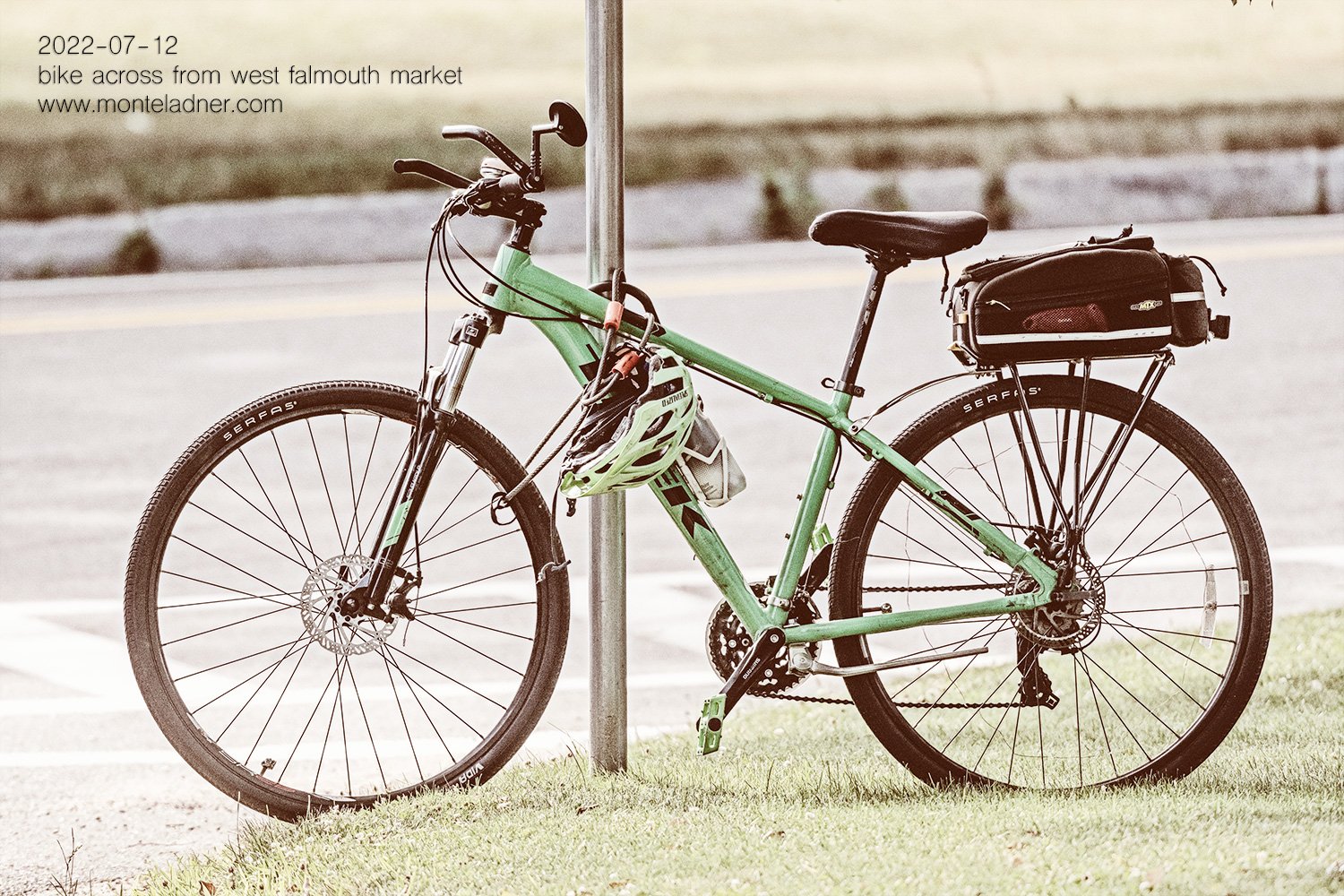
For several days I found this bike chained to a signpost across the street from the West Falmouth market as I was heading toward the bike path for my morning walk. It belonged to a young man coming off the bike path from his morning ride and headed into the market for a coffee and breakfast. I only had one short conversation with him in which I told him how much I liked the color of his bike. He replied by telling me he’s owned it for five years.
I assume he was a tourist since I haven’t seen him since his regular appearances ended after about five days. I’ve been a year-round resident on Cape Cod for 19 years. The summers always produce conflicting emotions for me. I don’t like the abrupt increase in the town population with the associated crowding and chaos that comes with it. But so many people in a good mood and looking to have fun at the beach create an irresistible summertime vibe that I’ve grown to appreciate.
The first day I spotted this bright green bicycle, I immediately reached for my camera to capture an image that nicely describes summertime in my little beach town. I imagine that the summers here feel like they haven’t changed in decades for so many of us, residents and tourists alike. Maybe it’s that nostalgic feeling that keeps the tourists coming back.
Monte
troglodytes

Troglodytes
Often when I read an editorial in the newspaper or hear a talking head make a comment with which I disagree, I will call them a pejorative name, like a troglodyte. Troglodyte is a noun that means someone who lives in a cave. It is supremely satisfying for me to exclaim, "what a troglodyte!" when I'm offended by another person's opinion on an important issue. I frequently scream "troglodyte!" at my computer screen in today's hyper-divided and politically polarized society.
Some people will say I'm childish and insecure. I can only riposte with a predictably immature response like: "everybody does it," because everybody does. It seems like typical human nature to bark insults at people with whom we disagree.
But troglodyte also means a person who lives in solitude, which vaguely describes me. It is a thought-provoking hint that troglodyte can work for both my perceived adversaries and me. Could I have more in common with the people I disparage than I might initially recognize? What if, in addition to being troglodytes, we also share other similarities? Maybe I should look for the common ground between us before casting out inflammatory comments and engaging in name-calling. Wouldn’t it be something if this became a mass epiphany in our world?
But that’s just the sort of woke thinking with which the troglodytes will never engage!
I just can’t help myself. I’m only human.
Monte
five little coyotes
Five little coyote puppies have appeared in my backyard. I’m already worried about their future in a dangerous world.
Monte